
 channel247 online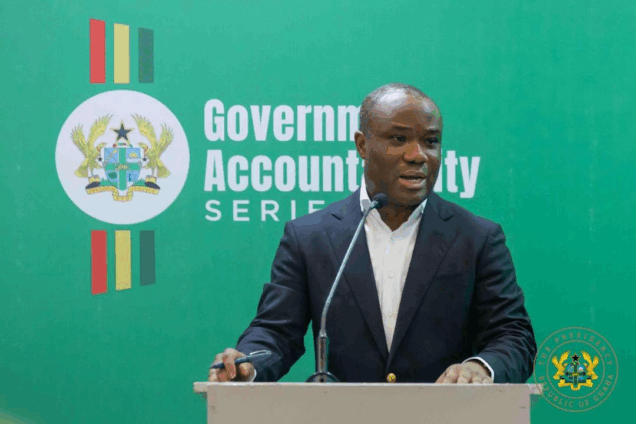
Government has confirmed that ten separate petitions filed against the leadership of the Electoral Commission (EC) and the Special Prosecutor have been formally submitted to the Chief Justice for consideration.
Minister in Charge of Government Communications, Felix Kwakye Ofosu, disclosed this while addressing the Government Accountability Series in Accra on Wednesday, January 14. He explained that the President’s involvement in the process ends once the petitions are forwarded to the Chief Justice.
Mr Kwakye Ofosu stated that out of the ten petitions received, seven are directed at EC Chairperson Jean Mensa and her two deputies, while the remaining three target Special Prosecutor Kissi Agyebeng. According to him, the petitions were transmitted to the Chief Justice a few weeks ago in line with constitutional and statutory requirements.
“The President has no mandate beyond forwarding the petitions to the appropriate authority, which in this case is the Chief Justice,” he said, adding that further action now rests with the judiciary.
He noted that the Chief Justice is expected to determine whether a prima facie case has been established. Only after such a determination will the President be required to take further steps as prescribed by law.
The petitions, submitted by individuals and groups, raise allegations of misconduct. Those against the Special Prosecutor include claims of incompetence and abuse of office, while the petitions against the EC leadership centre on issues of accountability and the management of the Commission.
Under Section 16 of the Office of the Special Prosecutor Act, 2017 (Act 959), any petition seeking the removal of the Special Prosecutor must be referred by the President to the Chief Justice within seven days. The Chief Justice then has 30 days to assess whether the allegations disclose a prima facie case.
Where a prima facie case is established, the Chief Justice is required to set up a three-member committee to investigate the allegations and submit recommendations to the President, who is constitutionally bound to act on the findings.
Mr Agyebeng, who has been in office since 2021 after taking over from Martin Amidu, has attracted both praise and criticism. While some commend the Office of the Special Prosecutor for strengthening accountability, others argue that its performance has not always met public expectations.