
 channel247 online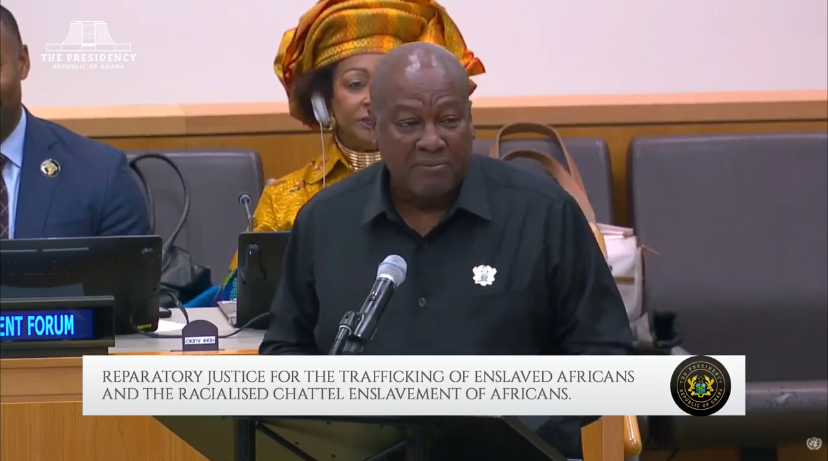
President John Dramani Mahama has criticised what he describes as growing distortions and erasure of slavery in educational systems, warning that such trends threaten global efforts toward justice and historical accountability.
Speaking at a United Nations high-level special event on reparatory justice in New York on March 24, 2026, Mahama expressed concern over the misrepresentation of slavery in textbooks and public discourse, particularly in parts of the Western world.
He cited instances where educational materials have downplayed the brutality of slavery, including the use of terms such as “workers” instead of enslaved people, arguing that such language diminishes the suffering endured by millions of Africans.
Mahama also pointed to policies that restrict the teaching of slavery, racism and Black history in some schools, warning that these actions risk fostering ignorance among younger generations.
“When words are used to distort reality, they create mythology,” he said, stressing that accurate historical representation is essential for preserving truth and dignity.
The former president emphasised that the transatlantic slave trade was a deliberate system of dehumanisation, built on racial hierarchies that falsely portrayed Africans as inferior. He warned that attempts to soften or erase this history undermine global understanding of its long-term consequences.
According to him, confronting the truth about slavery is a critical step toward achieving reparatory justice and healing for affected communities across Africa and the diaspora.
Mahama urged the international community to resist efforts to rewrite or sanitise history, calling instead for education systems that reflect the full extent of the atrocities committed.
He reiterated his support for a United Nations resolution recognising the trafficking and enslavement of Africans as one of the gravest crimes against humanity, describing it as a safeguard against forgetting.
He concluded by calling on world leaders and educators to uphold truth in historical narratives, stressing that honest education is key to building a more just and informed global society.
 Yaw Boagyan