
 channel247 online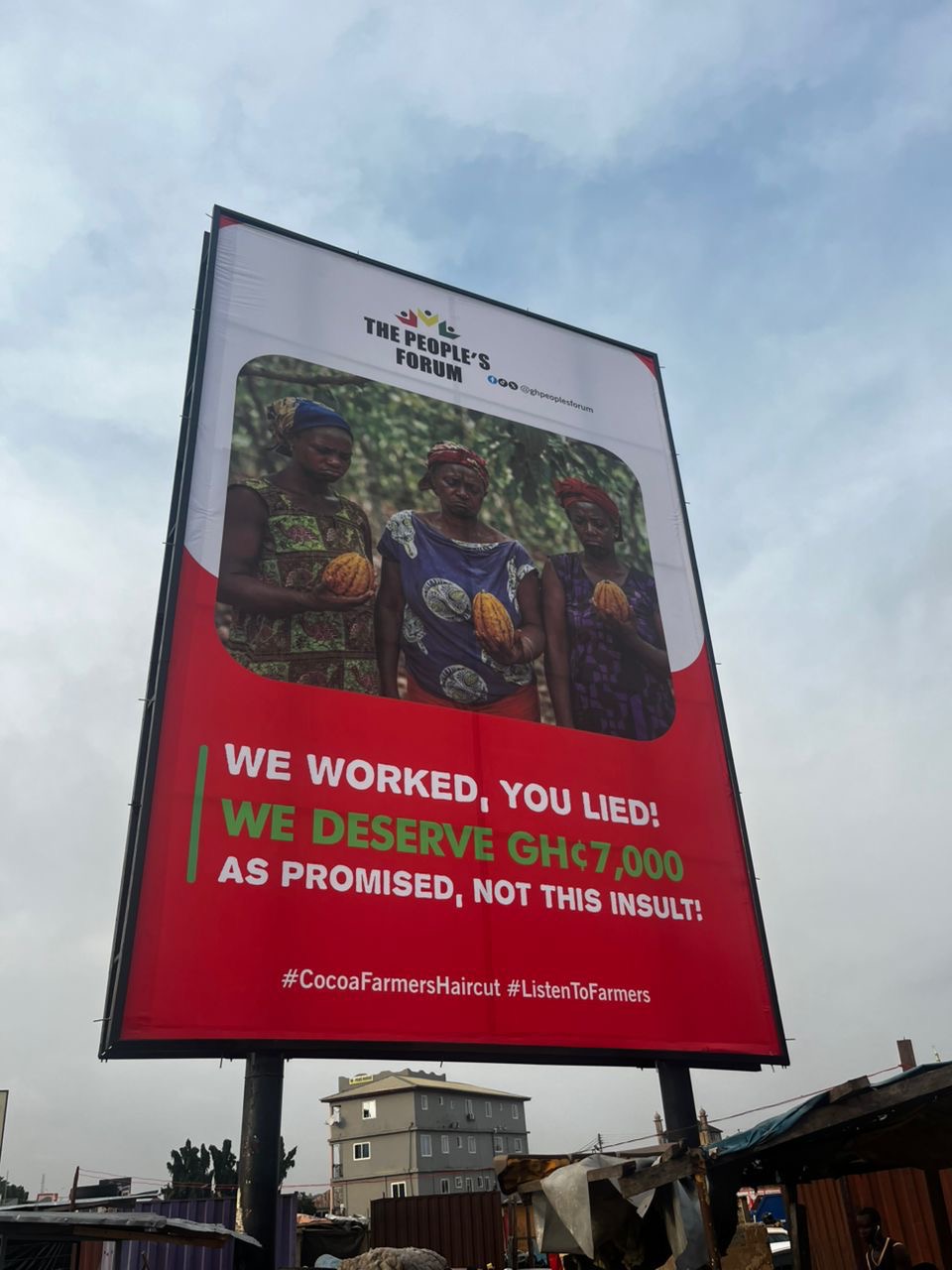
A fresh wave of discontent is sweeping through Ghana’s cocoa-growing communities as a series of bold billboards mounted by The People’s Forum protest the government’s decision to reduce the farmgate price of cocoa to GH¢2,587 per bag.
The billboards, which appeared in parts of Accra and other key locations, carry the striking message: “Our sweat, their excuses, GH¢2,587 per bag? How do we survive?” The visuals feature a weary-looking cocoa farmer seated among harvested cocoa pods, underscoring the economic strain many producers say they are facing.
The campaign follows the February 12 announcement by Finance Minister Cassiel Ato Forson, who confirmed that the Producer Price Review Committee had adjusted the producer price for the remainder of the 2025/2026 cocoa season to GH¢41,392 per tonne equivalent to GH¢2,587 per 64kg bag. The new rate represents a 28.6 percent reduction from the GH¢3,625 per bag set at the start of the season in October 2025.
Government has attributed the downward review to falling global cocoa prices and liquidity challenges facing the Ghana Cocoa Board. Officials say international cocoa prices have declined sharply from record highs in late 2024 to significantly lower levels in recent months, affecting projected revenues. They also maintain that the revised producer price represents about 90 percent of the achieved Free on Board export value, an increase from the previous 70 percent share to farmers.
However, cocoa farmers in regions such as Western North, Ashanti and Eastern argue that the cut could severely affect their livelihoods. Many say rising costs of fertilizers, pesticides and labour have already eroded their margins, and a mid-season reduction leaves them with little room to absorb further shocks.
The People’s Forum described the billboard campaign as a “wake-up call” aimed at drawing national attention to what it calls an unprecedented mid-season price cut. The group says it has engaged farmers who feel the new rate is unsustainable and are demanding urgent dialogue with authorities.
Photos of the billboards have circulated widely on social media under the hashtags #CocoaFarmersMatter and #JusticeForFarmers, sparking debate over the economic realities confronting the sector versus the hardship faced by producers.
With cocoa remaining a key pillar of Ghana’s economy and a source of income for hundreds of thousands of households, the unfolding tension highlights the delicate balance between global market pressures and domestic welfare. Whether the public pressure will prompt a policy review remains uncertain, but the farmers’ message has clearly been thrust into the national spotlight.

 Yaw Boagyan